


Start with the markets where the brand needs protection. A U.S. registration provides U.S. federal protection. If you’re launching in Canada, Japan or Europe, you need to seek protection there too. Buying the matching domain gives you a web address. Trademark rights depend on the jurisdiction, the mark, and the goods or services it identifies.
The best route depends on how many markets you’re entering and how much risk sits with your home application. You can simplify filing and renewals across several markets by using the Madrid system. Direct filings give you independent applications and more control over how you describe your products in each country. An EU trade mark can cover all 27 EU member states through one application, and the UK needs separate coverage.
Compare international trademark filing routes
| Route | Coverage | Starting government fees | Best fit |
|---|---|---|---|
| Madrid System | Selected Madrid members | CHF 653 black and white or CHF 903 color, plus designation and origin fees | Several markets and a strong home mark |
| Direct national filing | One jurisdiction per filing | Varies by office. U.S. base filing is US$350 per class under Section 1 or 44. | Independent coverage or a non-Madrid market |
| EUIPO | All 27 EU member states | €850 online for one class | An EU-wide launch |
| UK IPO | United Kingdom | £205 online for one class | UK-specific protection |
The fees shown are starting government charges checked November 16, 2026. Add any home-office certification, local representation, search, translation or application-response costs that apply. Use the WIPO fee calculator to price your actual Madrid designations, and check the EUIPO fee schedule and UK IPO application fees when comparing them with direct filings.
How the three filing routes work
Madrid System
An eligible applicant files through a trademark office with which they have a qualifying connection, such as nationality, domicile, or a qualifying business establishment. The application is based on a pending application or registration for the same mark at that office. The office certifies it, WIPO checks formal requirements, and each designated office applies its own rules. You can use the Madrid member profiles to check coverage and local requirements before choosing designations.
The main trade-off is five years of dependency. Suppose you use a pending U.S. application to designate Japan, Germany, and Australia. Eighteen months after the international registration date, a competitor successfully challenges that U.S. application. If the U.S. application is refused for the covered goods, WIPO can cancel the corresponding international coverage. If only some goods are removed, the corresponding international coverage may be narrowed. A proceeding begun within the five years can still have consequences if it concludes later.
The Madrid Protocol’s transformation procedure can preserve the relevant filing and priority dates through new national or regional applications if you meet the conditions and file within three months of cancellation. Local filings and counsel can add substantial expense. If you already know your home application is likely to face a challenge, compare the cost of filing independently from the start.
Direct national filing
You apply to each national office under its own rules, using local counsel where required or appropriate. Each application stands independently of your home mark. This can help if you need a market outside Madrid, if your home mark is vulnerable to infringement, or if a target market needs coverage beyond the goods and services listed in your home application.
You’ll manage separate dockets and pay office and legal fees by market. If you’ve already made a qualifying first filing, ask whether the Paris Convention’s six-month trademark priority window applies before scheduling the foreign filings.
Regional filing through EUIPO
An EU trade mark is a single right across the EU. It can be efficient when you sell in several member states, but an earlier right in one member state can support an opposition that affects the EU-wide application. If most of your launch is concentrated in one or two markets, compare national filings with an EU-wide filing. In some cases, an unsuccessful EU application can be converted into national applications where the obstacle does not apply, subject to fees and deadlines.
The UK is a separate jurisdiction. A launch covering France, Germany and the UK could use an EU filing plus a UK filing, Madrid designations for both territories, or national filings where the business needs them. Compare the exact market coverage, the independence of each application, and who will handle objections.
Run a clearance search before you pay
Search the exact name, close spellings, similar sounds, translations, and relevant logos. Compare goods, services, and sales channels as well as the names themselves. Two products can be related even when they appear in different trademark classes. A result in an unrelated industry may warrant a different assessment from a close match selling to the same customers.
Start with the WIPO Global Brand Database for a broad search, then use TMview and the USPTO trademark search system where relevant. Check the individual office register for each priority market and look for actual use in that market too. If a result is marked dead or expired, verify whether the business still uses the mark and whether enforceable rights may persist.
Use the Nice Classification to identify your classes, then check wording requirements in each office. Write down what you sell today and what you have a concrete plan to offer. Filing fees are generally difficult to recover once an application is submitted, and a class number alone does not define the scope of protection. If a search finds a close match in a core market, ask local counsel to assess it before paying the filing fee or committing to packaging.
Best services by use case
WIPO Madrid System
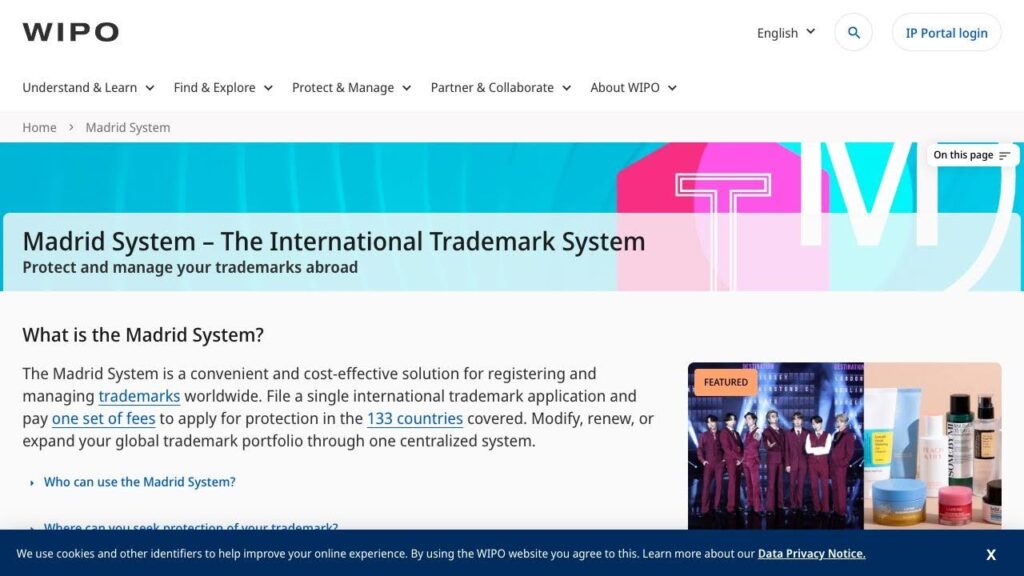
Best for coordinating filings across several member markets when you have a strong home mark.
WIPO provides the filing and management system. U.S. applicants filing a new outbound application use Madrid e-Filing through WIPO, with the USPTO still handling certification. The USPTO fee schedule lists electronic certification at US$100 per class for one basic application or registration and US$150 per class if based on more than one. The current platform collects the certification and WIPO fees in Swiss francs.
Use Madrid to compare the combined cost of the countries you actually need. Include the cost of any foreign counsel likely to be needed if an office refuses protection. You can add markets later through subsequent designation, which has its own fees and does not reset the international registration’s renewal date.
Marcaria
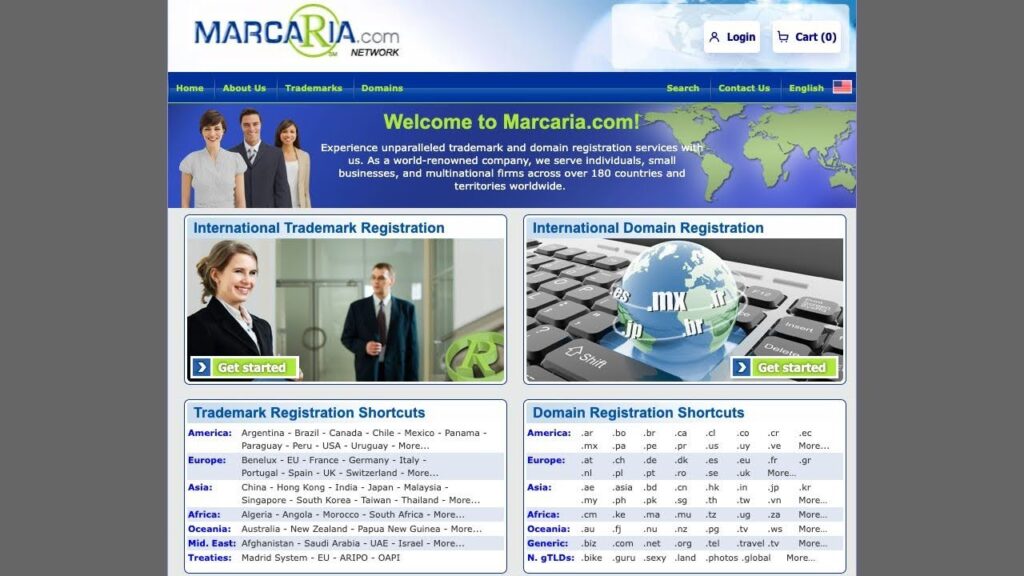
Best for comparing country-by-country filing options with one point of contact.
Marcaria lists trademark search and registration services by jurisdiction, including regional filings. It can be a starting point when you need several local applications and want to compare the scope and fees in one place. Search, application and registration steps may be priced separately. Check whether the quote includes official fees, certificate charges and local-agent work in each jurisdiction.
For a market where a refusal or opposition could delay your launch, ask who will review the clearance findings, who will act before the office and how their work will be billed. A single contact simplifies coordination, and a clear quote lets you compare it with appointing local attorneys yourself.
Gerben IP
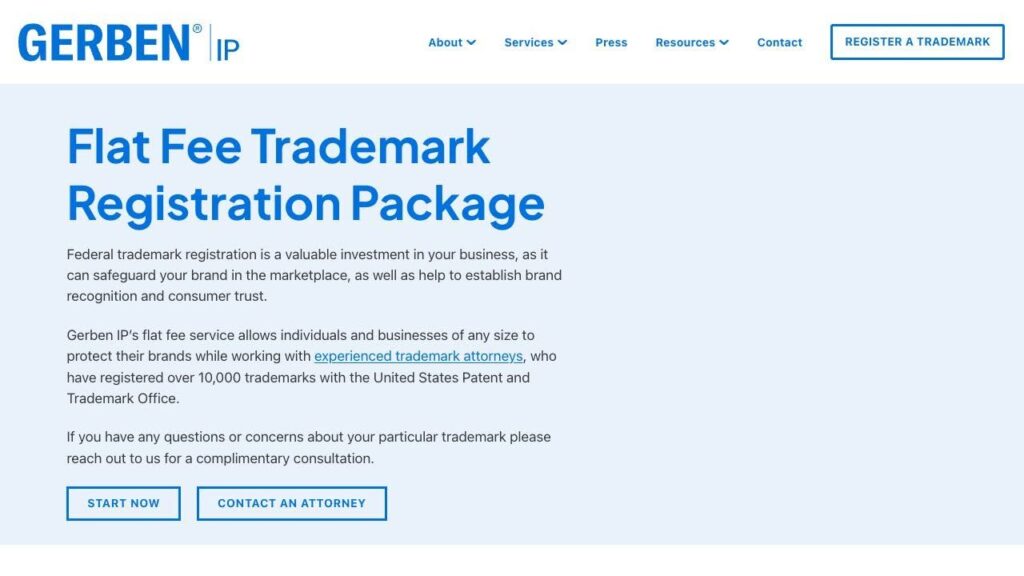
Best for a brand that wants a specialist’s clearance opinion before investing in a U.S. filing.
Gerben IP publishes a US$3,000 U.S. legal fee plus government fees for qualifying applications. Its package includes a federal, state and common-law search, legal analysis, filing and specified routine post-filing work. With the US$350 base filing fee, a qualifying one-class application starts at US$3,350. The published legal fee applies to eligible use-in-commerce filings in up to two classes. Ask for a separate quote for intent-to-use filings, international work and substantive disputes.
This is a useful benchmark when the brand is already generating revenue or a change of name would be costly. If foreign clearance matters as much as the U.S. search, ask which territories the engagement covers and whether the firm will coordinate with local counsel.
Trademark Engine
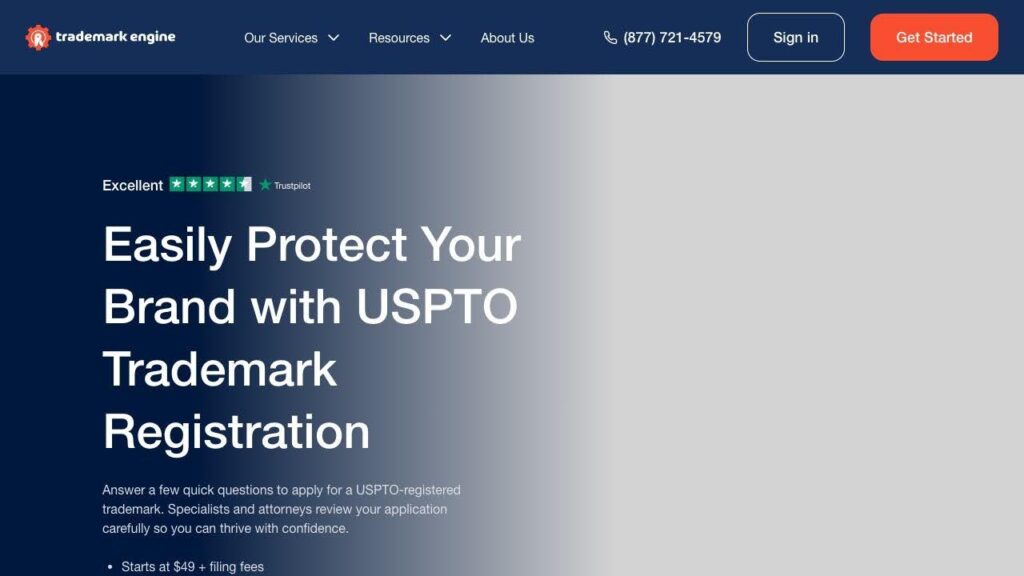
Best for a straightforward U.S. filing on a limited budget.
Trademark Engine lists a US$49 Basic package, a US$350 base USPTO fee for one class, and a US$100 service and platform charge. That makes the starting one-class total US$499 before any surcharges or optional services. The Basic plan lists attorney review, and higher tiers include time for a consultation. Check the scope of the search and ask who will handle an objection after filing.
This package can help prepare the U.S. application you may later use as a Madrid basis, if eligible. Budget separately for the international application, foreign clearance and any local responses.
LegalZoom
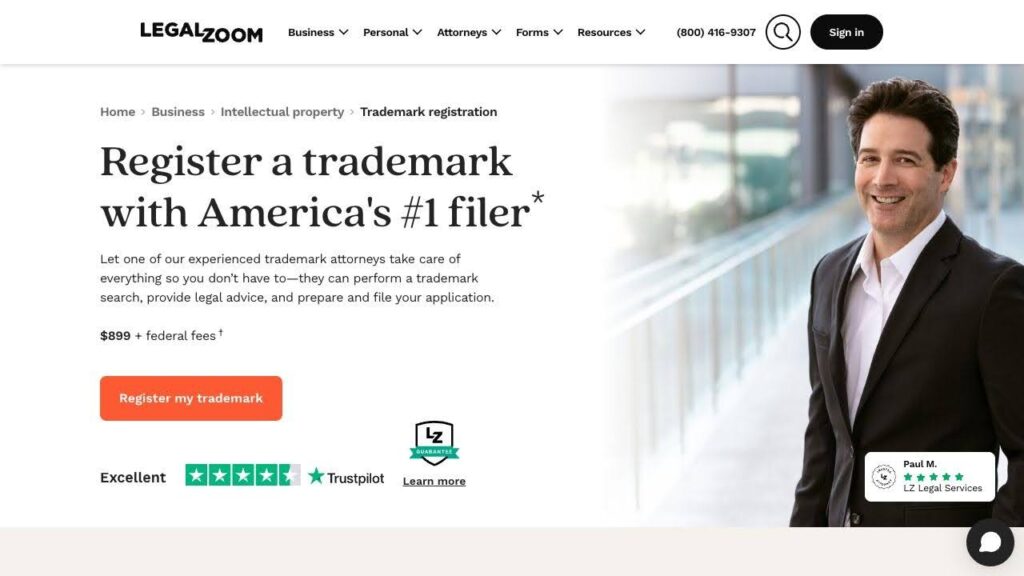
Best for U.S. applicants who want an attorney-led online filing package.
LegalZoom advertises a US$899 premium package plus federal fees. The starting total is US$1,249 for one class at the standard base fee. The package advertises a search, legal guidance and preparation and filing of the U.S. application. Review the engagement terms for which objections are included and check whether monitoring or other add-ons renew.
Ask for international work to be quoted separately if you want to use the U.S. application as the basis for Madrid or are preparing to launch abroad. Compare the scope of the clearance advice with the needs of your brand and the number of markets you’re entering.
EUIPO and UK Intellectual Property Office
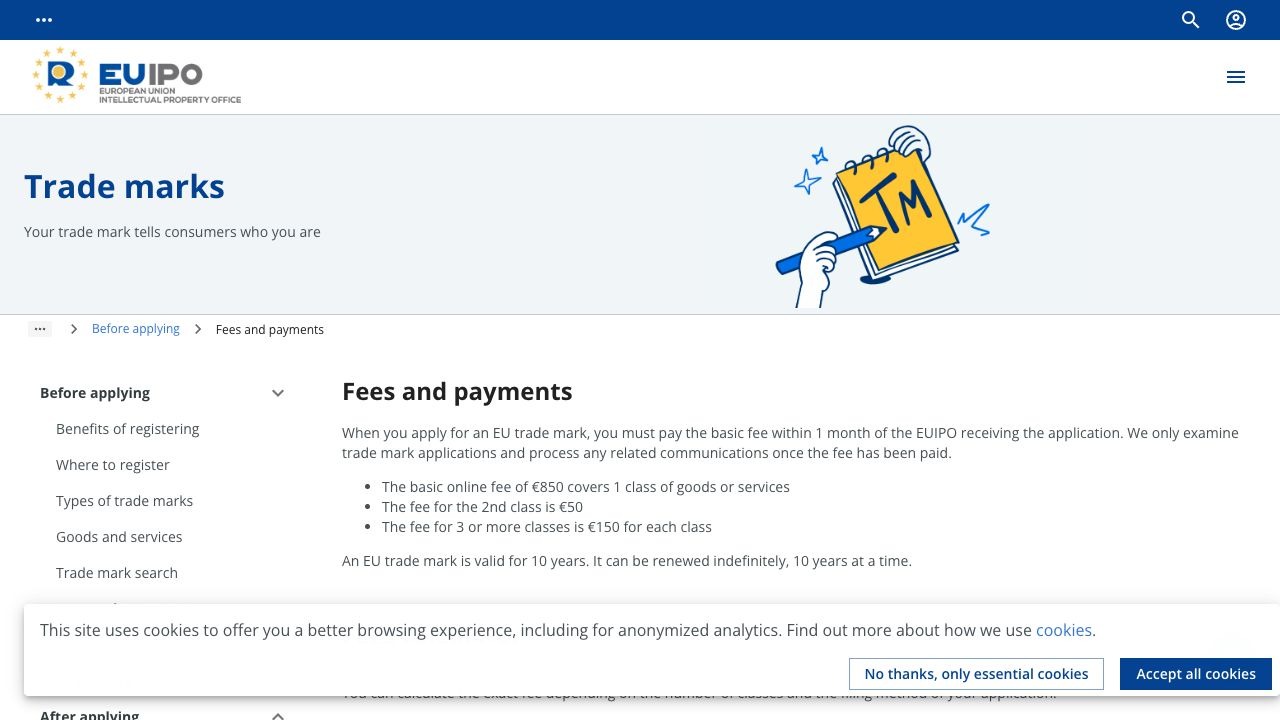
Best for founders whose filing priorities are the EU, the UK or both.
The EUIPO online base fee is €850 for one class. It adds €50 for the second and €150 for each class from the third onward. The UK IPO’s standard online application costs £205 for one class and £60 for each additional class. Check the EUIPO representation rules if you lack a qualifying EEA domicile or establishment. For a direct UK filing, the UK address-for-service rules require an eligible address, which can be supplied by a representative.
A local IP attorney can compare national, EU-wide and Madrid coverage and handle objections in the relevant jurisdiction. Ask for a written quote that identifies which searches, responses, translations and third-party oppositions are included.
Filing in Asia-Pacific
Japan, Australia, China, South Korea and India are all available through Madrid. Each office examines its designation independently. Build the shortlist around where you’ll sell, manufacture or license the brand, then check each office’s examination practice, acceptable descriptions and requirements for responding to a refusal.
The USPTO’s China IP toolkit describes China’s generally first-to-file system. If manufacturing or selling there is on your roadmap, have qualified local counsel assess the English name, any Chinese-language brand and relevant goods or subclasses early. For Japan, South Korea, India and Australia, compare local clearance findings and ask whether the goods and services in your home filing will work as drafted. You can use Madrid for several markets and still file independently in a high-priority jurisdiction where local advice points to a different route.
Six questions to ask before you choose
1. Which markets matter this year? Prioritize planned sales, distribution and manufacturing. Record launch dates and any priority deadline. A country that accounts for most of your expansion budget may justify closer clearance or an independent filing.
2. How secure is the home mark? Review the search and any pending objections. A strong home mark makes Madrid easier to justify. If the home mark is likely to be refused or narrowed, ask how dependent coverage would be affected and price direct alternatives.
3. How much legal work is included? Ask who conducts the search, who gives the written opinion, and who acts as attorney of record. If your business is domiciled outside the U.S., the USPTO’s attorney requirement generally calls for U.S.-licensed counsel before the office. An initial Madrid designation reaches the USPTO through WIPO, and a response to a U.S. refusal requires U.S. counsel for a foreign-domiciled applicant.
4. What will you pay in total? Separate official fees from provider fees, and price each class and destination. Under the USPTO’s surcharge rules, missing required information can add US$100 per class to a Section 1 or 44 application, and entering a custom goods or services description in the free-form field can add US$200 per affected class. An intent-to-use U.S. filing can also incur later fees for evidence of use or extensions.
5. Who handles refusals and oppositions? Ask for separate pricing for routine corrections, substantive refusals and disputes brought by third parties. In a Madrid filing, a provisional refusal is handled with the designated office under its own deadline. Find out who receives that notice and who contacts local counsel.
6. Who owns the renewal calendar? Ask whether reminders are included, where official notices go and whether the provider will actually file maintenance documents. Keep a record of the owner, classes, filing basis and deadlines so you can transfer the docket if you change providers.
Keep the registration alive
A standard U.S. registration under Section 1 or 44 generally requires a Section 8 declaration between years five and six after registration, then a combined Section 8 and 9 filing in the year before each ten-year anniversary. The USPTO’s maintenance fee schedule lists US$325 per class for the declaration and US$650 per class for the combined electronic filing. A six-month grace period is available with an added fee. U.S. protection obtained through Madrid has its own Section 71 use-declaration schedule and is renewed internationally at WIPO.
Use eMadrid to track international records, update contact and representative details, add designations, and renew the international registration every ten years. Check local requirements separately. Store dated evidence of use as you go and calendar the next deadline in each market. If a mark changes materially or the business changes hands, ask whether you need a new filing or an ownership recordal.
Frequently asked questions
How much does international trademark registration cost?
For a one-class filing, the direct government starting fees are US$350 for an eligible U.S. application, €850 for an EU trade mark and £205 for a standard UK online filing. Madrid starts at CHF 653 for a mark in black and white or CHF 903 in color, plus designation fees and any home-office charges. Legal assistance, clearance and responses are separate costs. Price the same mark, classes and markets on every quote.
How long does it take?
A straightforward UK filing can register in about three months under the UK IPO’s published timeline. With Madrid, designated offices typically have 12 or 18 months from notification to issue a provisional refusal, with possible exceptions for opposition. The notifications and response deadlines can differ by territory. Check the USPTO processing dashboard for live U.S. estimates.
Can I combine Madrid and direct filings?
Yes. You might file directly in a core market that needs independent coverage and use Madrid for several others. If you qualify for a priority claim, coordinate the timing before the deadline. Confirm how each filing describes the goods and services so your portfolio covers the launch you actually plan.
Does a domain name give me international trademark protection?
Domain registration gives you control of the address under the registrar’s terms. Trademark rights depend on local law, your use of the mark and any registrations you obtain. Search before committing to a domain, packaging or advertising in a new country.
What happens if my home mark is challenged?
During Madrid’s first five years, a successful challenge to the home mark can cancel or narrow the corresponding international registration. A challenge begun in that period can matter even if decided later. Ask promptly about transformation if WIPO cancels coverage and you want to preserve the relevant dates through local filings.