


Quick comparison of the best LLC formation services
| Provider | Formation fee | Agent, year 1 | Agent renewal | Best for |
|---|---|---|---|---|
| Northwest | $39 | Included | $125/yr | Most founders |
| ZenBusiness | $0 Starter | $99 if eligible | $199/yr | Guided setup |
| LegalZoom | $0 Basic | $249 | $249/yr | Legal support |
| Bizee | $0 Basic | Included | $149/yr | Low upfront cost |
| Inc Authority | $0 | Included | $249/yr | Startup extras |
| BetterLegal | $299 | Separate quote | Confirm quote | Formation bundle |
| Rocket Lawyer | First filing with membership | $125 with Plus/Pro | $125/yr with Plus/Pro | Legal documents |
| Tailor Brands | $0 Lite | $199 | $199/yr | Branding |
Prices checked November 11, 2026. Add your state’s filing fee to every formation price. Registered agent prices apply when you choose the provider’s agent service. Where an introductory offer is shown, check eligibility and the renewal amount before paying.
Northwest Registered Agent is our top pick. Its $39 formation package includes a year of registered agent service, and the published $125 annual renewal makes it easy to budget. If keeping the initial bill as low as possible is your priority, Bizee offers $0 formation and includes the first year of agent service. If you already have an eligible agent and feel comfortable with your state’s online form, filing directly can cost less than either option over time.
We compared public formation prices, registered agent terms, ongoing subscriptions and the type of help each service offers. We gave extra weight to clear renewal terms and services that solve common problems for first-time founders. The screenshots show public provider pages, and the rankings are based on published terms. Refund terms can depend on the product, when work starts and whether the state has received the filing, so check the policy on the order you’re buying.
What you’ll pay in year two
The cheapest formation plan can become more expensive once a free registered agent year ends. To see how that works, consider a Colorado LLC. The state charges $50 for online articles of organization and $25 for a periodic report. The illustration assumes you keep the same provider’s agent, file the periodic report yourself, skip optional add-ons and qualify for any stated introductory price.
| Provider | Formation and year 1 | Year 2 | Two-year total |
|---|---|---|---|
| Northwest | $89 | $150 | $239 |
| ZenBusiness Starter | $149 with offer | $224 | $373 |
| LegalZoom Basic | $299 | $274 | $573 |
| Bizee Basic | $50 | $174 | $224 |
| Inc Authority | $50 | $274 | $324 |
| BetterLegal | $349 + agent | $25 + agent | $374 + agent fees |
| Rocket Lawyer Plus | $424 | $399 | $823 |
| Tailor Brands Lite | $249 | $224 | $473 |
Under those assumptions, Bizee is $39 cheaper than Northwest at formation and $24 more expensive at the first renewal. Across the two periods, Bizee totals $224 and Northwest totals $239. Inc Authority starts at the same $50 as Bizee, but the $249 agent renewal in its published Colorado guide brings the illustrated total to $324. For Rocket Lawyer, budget for the membership as well as the agent fee. For BetterLegal, get the agent quote before calculating a total.
These examples include a single initial state filing and the first annual report. Your actual billing calendar may look different. An agent subscription can renew on the day you bought it, while the state may set the report deadline by the month you formed. Keep both dates in your calendar. If you switch agents, budget for any state change fee and make sure the replacement is in place before canceling the old service.
An employer identification number, or EIN, is available free directly from the IRS. If the online application is available to you and your application is approved, the IRS can issue the number immediately. An EIN add-on can still be worth paying for if you want help with the application or need a different filing route, but the provider fee buys assistance.
The best LLC formation services, ranked
1. Northwest Registered Agent – Best overall

Northwest gives first-time founders a clear baseline: $39 plus state fees for formation, with the first year of registered agent service included and renewal at $125 per year. The agent receives service of process and official correspondence. Keeping it with the same provider can simplify the handoff after your state approves the filing.
Privacy is a practical reason to choose Northwest if you work from home. The company offers use of its address on formation filings where permitted, which can reduce how often you need to list a home address. Look at every field on the public filing before submitting. Your state may ask for a principal office, organizer or member address separately, and different rules can apply to banking, licenses and taxes. Confirm which addresses Northwest will let you use for those particular purposes.
Choose it if you want a professional agent and a predictable renewal. Consider another option if you already have an agent and only need basic filing. Bizee and other $0 providers lower the upfront service charge, and direct state filing keeps the transaction in your hands.
2. ZenBusiness – Best for guided online formation

ZenBusiness Starter has a $0 formation fee plus state fees. Its guided setup appeals to founders who want one place to see formation progress and manage the tasks that follow. Pro is listed at $199 per year and Premium at $399 per year. Pro adds tools such as an operating agreement and EIN assistance. Premium includes registered agent service under the published plan terms.
Starter customers who want ZenBusiness as their agent should price that service separately. ZenBusiness advertises $99 for the first year with a qualifying formation offer, followed by $199 annually. At checkout, check whether the offer applies, whether a plan already includes the agent, and whether any website or other trial has its own renewal. A first-year discount is useful only if the ongoing plan fits your budget.
Choose it if you want guided setup and expect to use the dashboard afterward. Consider another option if you only want filing and a registered agent at a lower recurring price.
3. LegalZoom – Best for legal support beyond formation
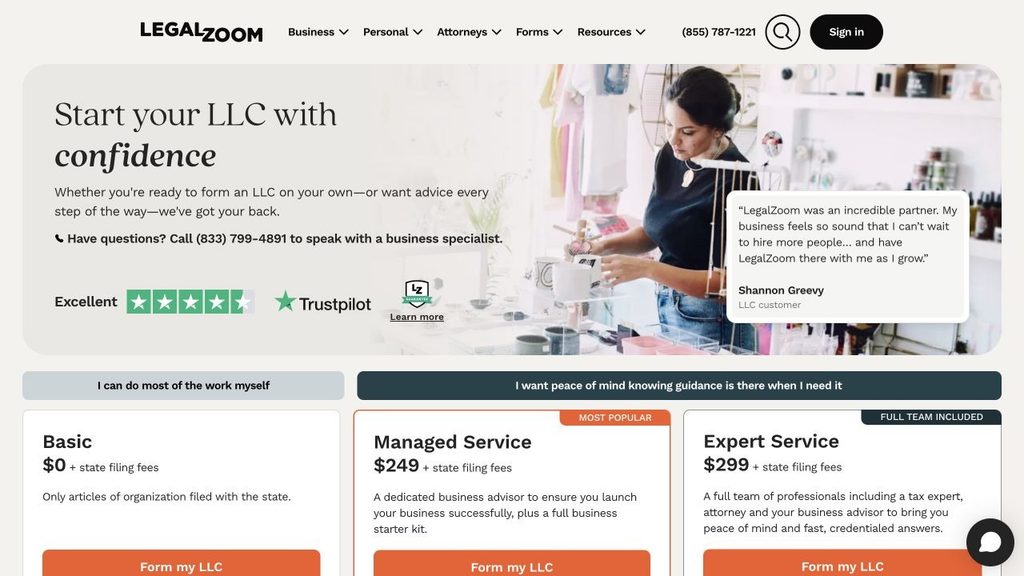
LegalZoom Basic starts at $0 plus state fees. The broader service catalog is the reason to put it on your shortlist. If you expect to ask a lawyer about a business contract or bring on a co-owner, compare the paid plans and attorney services. LegalZoom displays different paid offers, including a $249 Managed Service in the screenshot. Its published $249 Pro offer lists an operating agreement and attorney consultations under the terms of an introductory subscription. The consultation subscription renews at $49 per month after the first 30 days unless canceled. Check which topics, documents and consultation lengths your plan covers.
The standalone registered agent service is $249 annually. You can compare that price with independent agents in your state or appoint another eligible agent when ordering. If your legal needs are specific and time-sensitive, check that the available attorney service matches the question before choosing a plan.
Choose it if the legal services are part of your purchase decision. Consider another option if you only need standard formation and low agent costs.
4. Bizee – Best for keeping upfront costs low
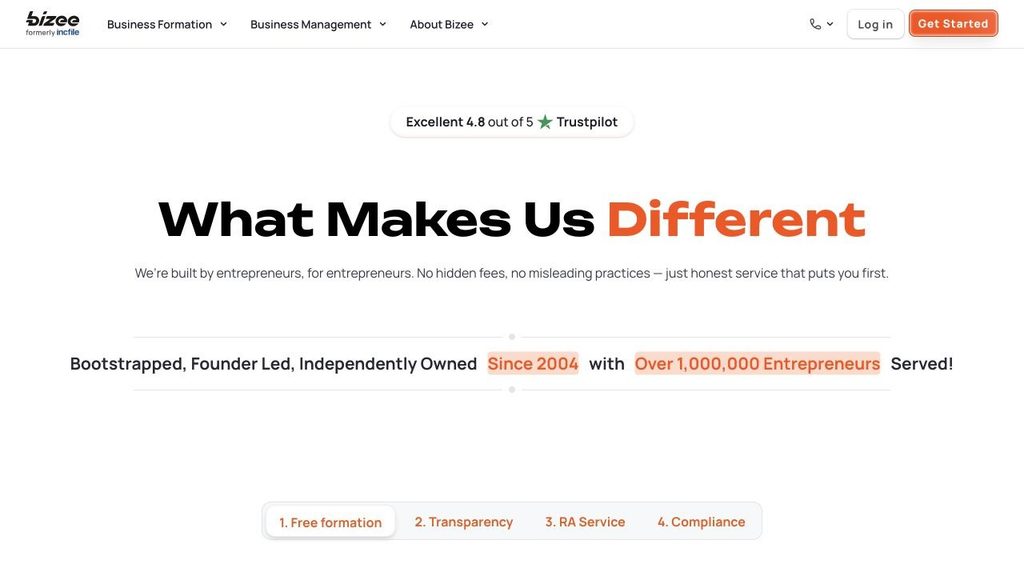
Bizee, formerly Incfile, has a $0 Basic formation plan and includes one year of registered agent service with formation. The agent renews at $149 per year. For a founder who wants basic filing and a professional agent, that combination has one of the clearest cost advantages in this comparison. You can handle the EIN and periodic reports directly if you want to keep the plan lean.
Pay attention to what happens after filing. Save your approved articles, verify the agent details on the state record and check which extras require activation. If you see a domain, website or mailbox offer, confirm the renewal terms and what it takes to move the service later. State filing, registered agent service and a website may each have their own billing and support arrangements.
Choose it if you want a low first bill and a professional agent. Consider another option if you value Northwest’s address-use policy and lower annual agent renewal.
5. Inc Authority – Best for free filing with startup extras
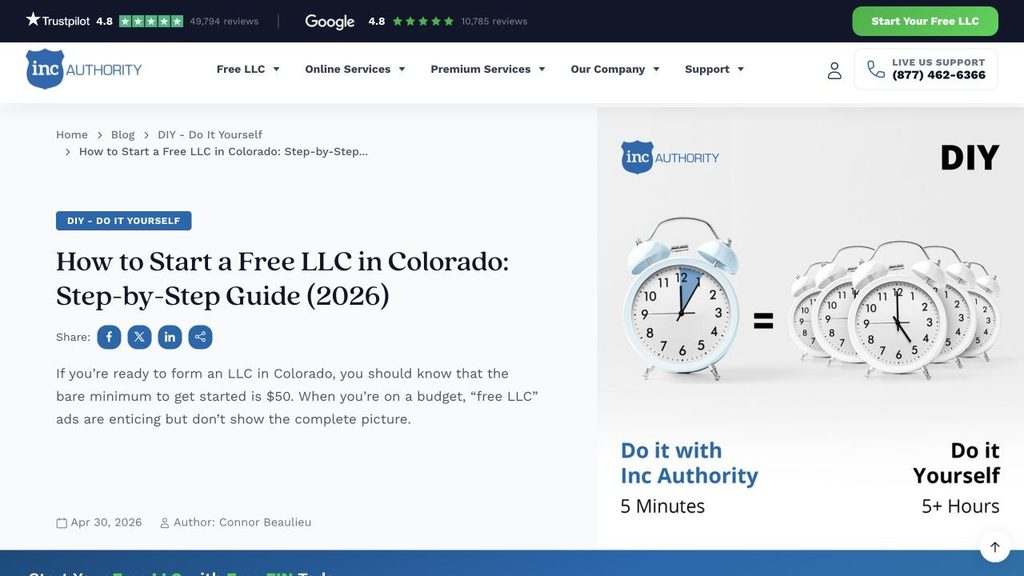
Inc Authority offers $0 base formation plus state fees and a first year of registered agent service. Its Colorado formation guide quotes $249 annually for agent renewal. The guide also promotes free EIN assistance. Review the current order summary for your state to see which extras are included, which are optional and what renews.
The value depends on which extras you would have bought separately. An EIN application is free through the IRS, so judge the convenience by the work it saves you. If you see a tax consultation or funding offer, check who provides it and whether any paid service follows. For a fair comparison with Bizee, hold the state and agent choice constant and look at the first renewal.
Choose it if the included setup help is useful to you and you’re comfortable checking the order carefully. Consider another option if you plan to keep the agent long term and want a lower published renewal.
6. BetterLegal – Best for a single formation bundle

BetterLegal lists $299 plus state fees for formation, including an EIN, an operating agreement and express processing. That package makes sense if you want one provider to handle those tasks and prefer to price them together. Registered agent service is listed separately. Ask for the agent and compliance prices and their renewal terms before comparing the package against a lower-priced filing service.
BetterLegal advertises a two-business-day turnaround. If you have a firm launch deadline, confirm whether the quoted timeline for your state covers preparation, submission or state approval. State processing and IRS timing can affect when your documents are ready. If speed is the only reason you are paying more, compare the state’s own expedited option and any separate fees.
Choose it if you want the EIN and operating agreement handled together with formation. Consider another option if you can do those tasks yourself and the lower-priced service meets your timeline.
7. Rocket Lawyer – Best for ongoing legal documents
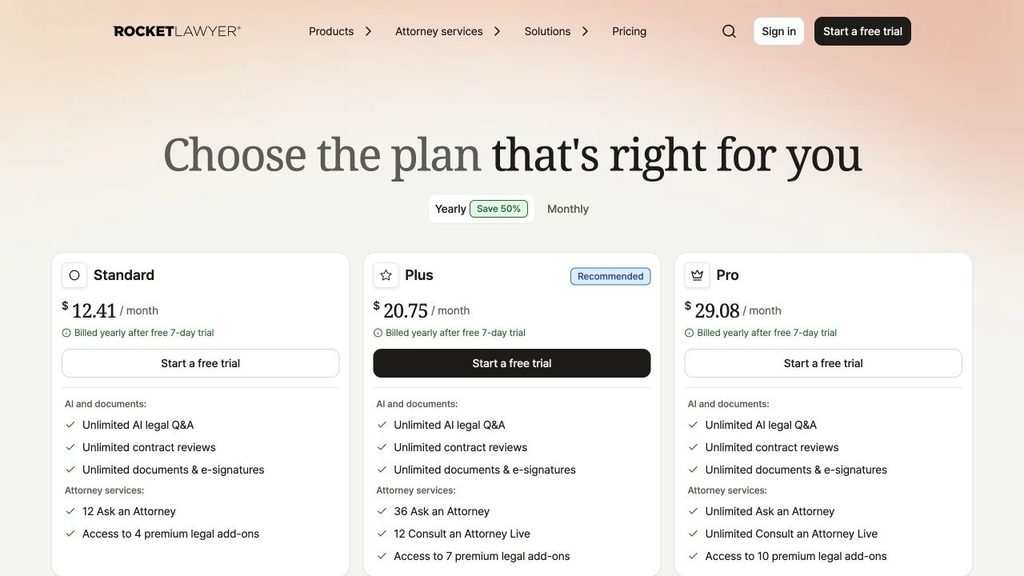
Rocket Lawyer is a good fit if you expect to use legal documents, e-signatures or attorney services throughout the year. Its pricing page lists annual memberships at $149 for Standard, $249 for Plus and $349 for Pro. The first business registration is included with a paid membership, and subsequent registrations are listed at $99 each, plus state fees. Registered agent service is listed at $125 per year as an add-on on Plus and Pro.
A Plus member who adds the agent would therefore budget about $374 per year before state fees at current annual prices. If you’re starting a trial, check the conversion date, billing cadence and cancellation terms. Also look at which attorney services are included at your chosen tier. A written response, live consultation and a paid legal advice session can have different rules.
Choose it if your business expects to use the membership after formation. Consider another option if your ongoing needs are limited to a registered agent and an annual report.
8. Tailor Brands – Best for branding alongside formation

Tailor Brands pairs LLC formation with tools for a website, logo and other launch tasks. Lite starts at $0 plus state fees. Essential is $199 per year and adds faster provider processing, an operating agreement and annual compliance features. Elite is $249 per year and adds website and logo tools and a domain for one year. The company lists registered agent service at $199 per year in its comparison guide. Verify the terms in your order, including any bookkeeping trial and separate state fees.
If the domain is part of the appeal, check who will be listed as the registrant, how much it costs to renew, and how to transfer it if you change website providers. You can also search for a domain independently before you commit to a legal name. That gives you more room to choose a name you can use both on paper and online.
Choose it if you expect to use the branding tools and would otherwise pay for them separately. Consider another option if your business already has a brand and a website.
Which state should you form your LLC in?
For a business operating mainly in one state, start by comparing the rules where you actually do business. If you form elsewhere and your operating state requires foreign qualification, you may pay two sets of filings and recurring fees and need a registered agent in both states. In this context, a foreign LLC can mean an LLC formed in another U.S. state. Offices, employees, inventory and other in-state activities can affect what you need to file. The rules vary by state.
Delaware. The state’s Division of Corporations lists a $400 annual tax for LLCs. Delaware may come up if you are discussing outside investment or a specific legal structure. If you expect to raise institutional capital, ask counsel whether investors will want a corporation and factor that entity choice into your decision before paying to create an LLC.
Wyoming. Wyoming’s LLC annual license tax is at least $60 and can rise based on assets located and employed in the state. Compare that fee with your full cost of operating elsewhere, including local filings, taxes and the cost of maintaining an agent in Wyoming.
Nevada. Nevada separates formation paperwork, an initial list and a state business license. Recurring list and license obligations matter when comparing Nevada with your operating state. Use the state’s current forms and fee schedule and check whether any exemption applies to your business.
How to form an LLC online
1. Check the name. Search your state’s entity database and review its naming rules. Also check the trademark landscape and look up the domain you want to use. State name availability, domain availability and trademark clearance are separate checks.
2. Choose your registered agent. Confirm the required in-state address and availability. If you plan to serve as your own agent, check your eligibility and which address details the public can see. If you hire an agent, ask what mail they accept and how quickly they notify you.
3. File the formation document. Your state may call it articles of organization, a certificate of formation or something similar. Enter the owners’ or managers’ details as required, check the addresses and effective date, and keep the approved copy. If you hire a service, ask when it expects to submit the filing and how you will receive confirmation.
4. Adopt an operating agreement. Record who owns the company, how decisions are made and how profits and responsibilities are shared. If there are multiple owners, agree on what happens if a member wants to leave, sells an interest or stops contributing. Get tailored legal help if a template leaves important questions unresolved.
5. Get an EIN and set up banking as needed. Apply after the state forms the LLC. Banks may ask for the approved formation documents, EIN confirmation, operating agreement and identification. Keep company transactions separate from personal spending and save the documents you will need again.
What to check before you pay
Compare the full cart. Write down the state charge, provider formation fee, registered agent fee, optional products, trial conversions and second-year total. Compare plans with the same choices selected. An upgraded package can be economical if you need its services and expensive if you only use one of them.
Check which address is public. Ask whether the provider’s address can appear on the formation document and what its mail forwarding service covers. Check the distinction between the registered office and your principal business address. Update the state if those details change.
Read the refund and timing terms. A guarantee may exclude state fees or services the provider has already performed. Ask about cancellation before submission and how to stop recurring services afterward. If you pay for speed, find out whether you are buying priority with the provider, the state or both.
Save the order summary. Keep a copy that shows the plan, included services, renewal prices and any terms you relied on. If the package includes an annual report service, check whether the provider submits the report automatically, waits for your approval or only sends reminders. Ask whether its price covers the government fee. The state can still mark the LLC delinquent if an expected filing falls through.
Check access after cancellation. Find out whether you can still download your formation documents if you drop the subscription. If your package includes a domain, mailbox or website, verify that you can move each service. Give the business an email address you control for state notifications and record which provider receives legal notices.
What to do after your LLC is approved
Keep your approved articles, signed agreement and EIN confirmation where you can find them quickly. Put state reports, tax deadlines, local license renewals and agent billing on a calendar. If your service sends reminders, keep your own copies and deadlines too. Check with the state or local licensing office for rules tied to your industry, location and hiring plans.
Start with the agencies that actually govern your work. A local shop may need a city license and a state sales-tax account, while a licensed professional may face separate entity rules and approvals. Write down the filing, the responsible owner, the agency and the deadline. If your LLC adds an owner, starts hiring or expands across state lines, revisit the list.
Set up the same recordkeeping for the public side of your launch. Keep the domain registration, website hosting and company email under accounts you control. If several founders share responsibility, agree on who can renew each service and who can recover the account if that person leaves. This also makes it easier to move to another website or formation provider later.
Under FinCEN’s final rule effective August 14, 2026, U.S.-created companies are exempt from federal beneficial ownership information reporting. Companies formed under the law of a foreign country and registered in a U.S. jurisdiction can still have obligations. Before paying for a BOI filing add-on, check the current rule against the entity you’re forming.
Frequently asked questions
Can you really start an LLC for $0?
Several providers charge $0 to prepare and submit a basic filing. You still pay the state’s applicable fee. You may also have agent, publication or licensing costs depending on your state and your choices. Compare the checkout total with the state’s current fee schedule.
Can I form an LLC without using a service?
Yes. Most states publish a form or online filing portal. Direct filing can be a good fit if your ownership structure is straightforward and you can handle the agent appointment, agreement, EIN and reminders yourself. A service can save time on paperwork, and a lawyer can help resolve questions about ownership or risk that a filing service is unequipped to address.
Can I be my own registered agent?
You may be able to if you meet your state’s rules. In practice, you need a qualifying address and must be available to receive legal documents. A professional agent can be useful if you work irregular hours, travel frequently or prefer to limit where your home address appears. Review the public filing before deciding.
How long does it take to form an LLC?
There are two timelines: how long the provider takes to prepare and submit the paperwork, and how long the state takes to approve it. The state, filing method and season can all affect the second. If timing matters, check the state’s current processing times and confirm whether expedited service affects the date you actually need.
Can I change LLC formation services later?
Your LLC remains registered with the state when you stop using the filing provider. If the company also serves as your registered agent, appoint a replacement and file the state’s change paperwork as required. Download your records first and review separate subscriptions such as mail forwarding, a website or a domain.